
The year 2026 is approaching with significant changes in the European economic landscape, new tax rules, and a financial context that continues to require informed decisions for both investors and companies.
If you are planning your investments or business financing for next year, this guide brings together the key information you need to keep track of.
1. The economic context for 2026
The Portuguese economy is expected to continue to perform relatively well between 2025 and 2027, showing resilience to external shocks.
According to projections by the Bank of Portugal (October 2025), economic activity will be supported by the strength of the labor market and the economy's focus on services. Also, monetary and fiscal policies are expected to contribute to the growth of domestic demand.
1.1 Economic growth (GDP)
In 2026, real gross domestic product (GDP) is expected to grow by 2.2%, the highest figure for the projection period (2025–27). This growth will be higher than that of the euro area, maintaining a positive differential. The main driver will be domestic demand, with a notable contribution from productivity, which is expected to average 1.0 percentage point between 2025 and 2027.
On the other hand, exports are expected to slow down over the period, with average growth of 2.0%, due to global trade instability and a lack of market share gains.
1.2 Inflation: stabilization closer to the ECB target
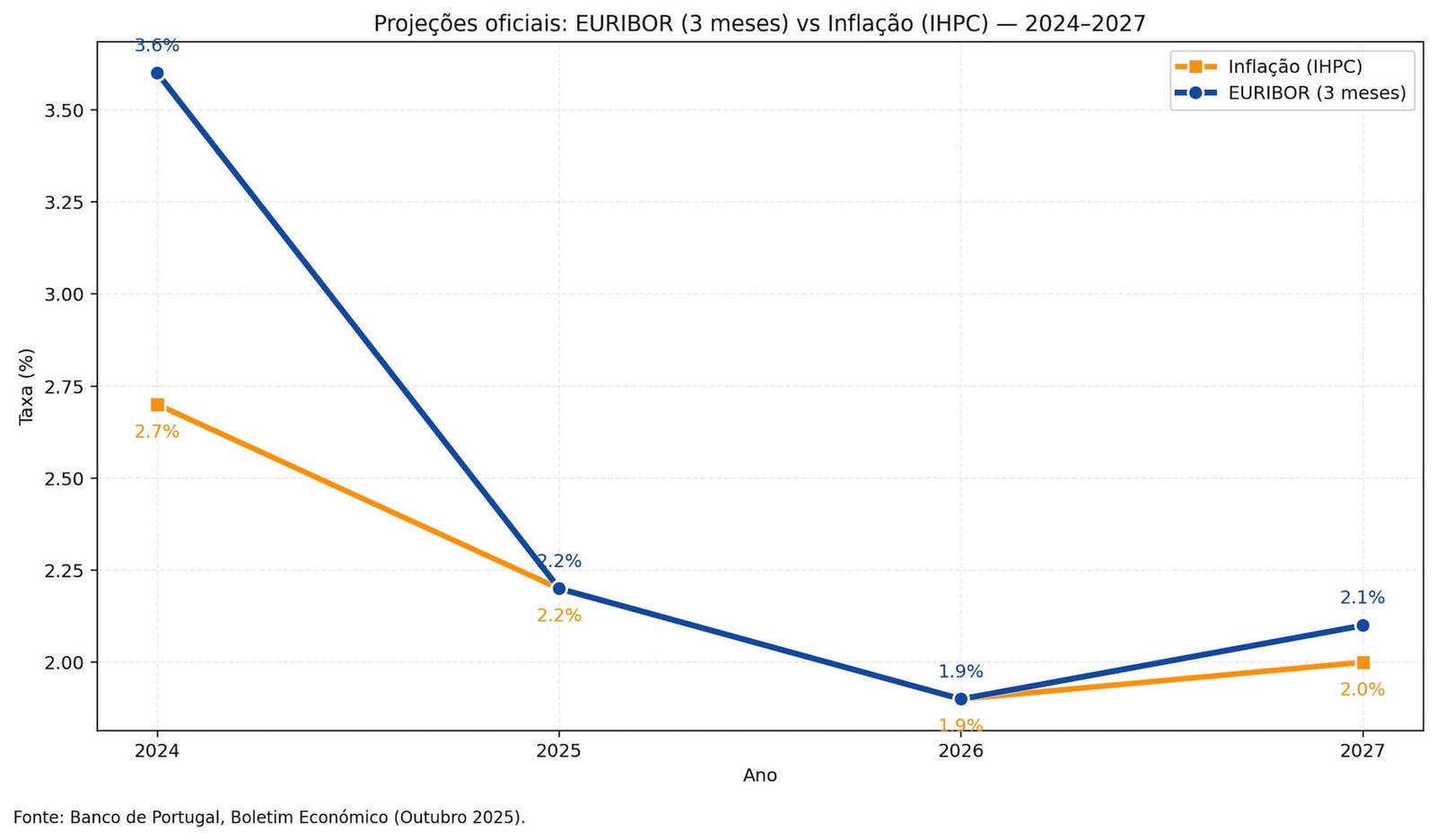
In 2026, inflation in Portugal, as measured by the Harmonized Index of Consumer Prices (HICP), is expected to moderate to 1.9%, approaching the price stability target of 2%. Core inflation (excluding energy and food) is also expected to fall to 2.2%.
This reduction will be driven by several factors:
Less external pressure, thanks to the appreciation of the euro and the fall in international commodity prices.
Slowdown in labor costs, with average compensation per employee growth falling from 5.1% in 2025 to 4.1% in 2026.
This has a direct impact:
Companies can plan investments and control costs with greater certainty.
Investors benefit from clearer conditions for assessing real returns and adjusting medium-term strategies.
The economic environment becomes more conducive to sustained growth and decision-making based on fundamentals rather than cyclical fluctuations.
1.3 Interest rates
According to the Economic Bulletin of the Bank of Portugal, expectations for short-term EURIBOR interest rates point to a slight reduction in 2026, reflecting the stabilization of the ECB's key interest rates and inflation in the Eurozone, which is expected to remain around the 2% target set by the ECB. Despite the uncertainty of the current economic climate, no significant changes in key rates are anticipated for next year.
This trajectory indicates relief in financing costs for households and businesses, although the implied interest rates on Portuguese public debt are expected to rise slightly (from 2.4% in 2024 to 2.6% in 2027), in line with long-term rates.
2. International uncertainty: what to expect in 2026?
Financial planning for 2026 must take into account not only domestic economic trends, but also the international context, which remains one of the greatest sources of uncertainty for businesses and investors in Europe.
2.1. War in Ukraine and prolonged economic impact
With the aim of strengthening Ukraine's financial condition, the European Commission has proposed two solutions for 2026-2027: EU loans and a loan linked to reparations.
The conflict continues to affect:
Energy prices (mainly gas and oil), despite relative stabilization since 2023.
Logistics and transportation costs.
Business confidence, especially in the industrial and export sectors.
The European Central Bank and the European Commission have consistently stated that the conflict remains one of the main downside risks to the European economy.
2.2. New US trade tariffs and pressure on European exports
An agreement has been signed setting tariffs of 15% on European products, maintaining surcharges of 50% on steel and aluminum, which affects industrial sectors and exporters. The United States is considering additional tariffs on European industrial products, automobiles, steel, and aluminum, goods considered “unfair competition.”
This could:
Reduce the competitiveness of EU exports;
Directly affect key sectors in Portugal (automotive, metalworking, machinery, pharmaceuticals);
Halt new investments due to increased regulatory uncertainty.
The European Commission has already warned of a possible impact on investment and economic growth due to the deterioration of trade relations.
2.3. The risk of global trade fragmentation
The ECB identifies the risk of “geoeconomic fragmentation” as one of the main challenges until 2026, with shorter and more expensive supply chains, increased costs for essential imports, and higher capital requirements for exporting companies.
2.4. What does this mean for investors?
For those investing in 2026, these trends imply:
Greater volatility in traditional markets (stock market, commodities);
Additional pressure on the European economy, with a possible slowdown in exports;
Stronger opportunities in alternative financing, especially in sectors less exposed to global trade (services, local logistics, small manufacturing, renewables);
Increased relevance of geographic and sector diversification.
2.5. What does this mean for companies?
For Portuguese companies, especially industrial ones:
Average order lead times may increase;
Access to bank financing may become more demanding;
Exchange rate volatility (EUR/USD) may affect margins;
There may be greater demand for alternative sources of financing, such as crowdlending and factoring, to maintain stable liquidity.

3. Important tax changes for 2026
3.1 IRS: automatic withholding on interest and capital gains
The State Budget for 2026 introduces changes to the IRS, including updating the brackets to reflect inflation and slight rate reductions at some income levels, with the aim of easing the tax burden on middle-income families.
Increase in the limit for income tax deductions relating to rental costs to €900 in 2026 and €1,000 in 2027;
Update of the minimum subsistence reference value to keep pace with the increase in the minimum monthly wage (RMMG).
The 2026 IRS provides for an update of the tax brackets above inflation (3.51%), which reduces the tax burden, and a 0.3 percentage point decrease in the rates for brackets 2 to 5. These measures mainly benefit middle incomes, while maintaining the progressivity of the tax. The final impact will depend on the approval of the 2026 State Budget and how the Government implements these changes.
3.2 Corporate income tax for companies
The following is expected:
A 1 percentage point reduction in the standard corporate income tax rate.
A reduction of 1 percentage point in each of the next two years, falling to 18% in 2027 and 17% in 2028.
SMEs and Small Mid Caps will now be subject to corporate income tax at a rate of 15% on the first €50,000 of taxable income.
For companies that resort to financing, this may mean greater predictability in tax planning and an improvement in cash flow through specific incentives.
3.3 Additional relevant tax benefits
Among the most relevant schemes in 2026 for individuals and companies:
For individual investors:
Some schemes that remain valid - RSP (Retirement Savings Plan), which maintains tax advantages in terms of income tax, such as a tax deduction of up to 20% of the amount invested, with limits between €300 and €400, and reduced taxation on redemption (8% on capital gains, if the legal conditions are met); Deduction of health and education expenses, where tax deductions for essential expenses are maintained, with limits defined per household; Benefits for properties undergoing urban regeneration: Exemption or reduction of IMI and IMT for properties located in urban regeneration areas; Benefits for donations, with tax deductions for donations to public or private entities with public utility status.
Incentives for sustainable investment - The Tax Benefits Statute (EBF) and the Investment Tax Code (CFI) include schemes that favor projects aligned with sustainable growth, energy efficiency, and green innovation, in line with European targets. In the State Budget for 2026, this is reflected in ISV and IUC exemptions for electric vehicles, reduced VAT for solar installations, support for residential chargers, incentives for biomethane and the circular economy, as well as pressure to eliminate CESE and strengthen the energy transition.
For businesses:
Changes: end of indirect SIFIDE (via funds), reinforcement of direct SIFIDE, greater transparency, and the possibility of investing up to 20% in complementary productive innovation.
Benefits for hiring and salary increases - Extension of the tax incentive for salary increases and partial exemption from income tax and contributions for productivity and performance bonuses, up to 6% of the annual base salary.
Productive investment support schemes, including the RFAI (Tax Support Scheme for Investment), with a deduction from corporate income tax for investments in non-current assets, and the ICE (Tax Incentive for Company Capitalization), with a tax increase to strengthen equity capital.
4. What investors should prioritize in 2026
4.1 Diversification and protection against macroeconomic risks
With inflation close to target and interest rates stable, diversification remains essential to balance risk and return. Here are the main recommended assets:
Fixed-rate instruments - With monetary normalization and rates still attractive, sovereign and investment-grade corporate bonds offer predictability and lower volatility and can form the defensive core of an investment portfolio.
Crowdlending - An alternative for investors seeking diversification outside traditional markets, with potentially higher returns than traditional savings instruments.
Equity, bond funds or ETFs are good ways to build well-diversified portfolios, thus avoiding the specific risk of individual securities and with higher appreciation potential.
Dividend Stocks - Companies with stable dividend policies in resilient sectors (energy, basic consumption, utilities).
4.2 Crowdlending: why it will gain relevance in 2026
In a context of low bank interest rates and economic stability, crowdlending becomes an even more efficient tool:
Attractive returns;
Risk assessed by external entities;
Complete information about each project;
Possibility of investing in real companies in the real economy;
Platforms with auction models, such as Daskapital, also allow investors to set the minimum rate and the market to adjust profitability in a fair and transparent manner.
Checklist for 2026
Practical checklist:
Update your annual budget - Review your income, expenses, and emergency funds.
Assess the impact of interest rates - Simulate scenarios with high, medium, and low interest rates.
Prepare your tax return - Organize your interest income, automatic withholdings, and investments that must be reported.
Set your financial goals - Short, medium, and long term.
Reassess the risk level of your portfolio - The markets in 2026 will be stable, but not immune to volatility.
Explore new opportunities - Crowdlending, retirement savings plans, funds, bonds, alternative investments.
Financial planning for 2026 requires information, advance preparation, and a balanced strategy.
With the economy stabilizing, changes in inflation, and an increasingly automated tax landscape, both investors and businesses are in a position to make safer, more long-term decisions.
A diversified approach, combining traditional products, modern alternatives such as crowdlending, and conscious tax management, will be essential to take advantage of next year's opportunities.
Frequently asked questions
Invoice Advance is a crowdfactoring solution for short-term financing that allows companies to anticipate the payment of invoices receivable, obtaining immediate liquidity. Invoice Advance is managed by Daskapital España S.L., a subsidiary of Das Kapital Lda.
In the Invoice Advance collaborative financing model, companies publish the credits they hold on their customers on the Daskapital platform, and investors compete with each other to purchase, at a discount, part or all of the invoice. Through an auction process, they define the amount they wish to invest and the minimum return they require, and companies will be financed by the group of investors demanding the lowest interest rate.
On the invoice due date, the debtors (the company's customers) pay the credit, returning the capital invested to the investors. The profit comes from the difference between the amount invested in the invoice seller and the amount received from the invoice payer, which corresponds to the discount.
Crowdfactoring is a form of collaborative financing in which companies can receive advance payment for receivables owed by their customers through online platforms such as Daskapital.
In this model, investors purchase invoices (partially or in full) at a discount (which translates into a rate of return), advancing their value to companies. This allows companies to quickly obtain the financing they need, while investors earn a financial return by acquiring the right to receive payment of the invoice amount (partial or full) on the due date.
Invoice Advance offers advantages for both investors and companies.
For investors, it allows them to diversify their portfolio with short-term investments and above-average returns, choosing the invoices in which to invest (and the consequent level of risk and maturity) and the minimum rate of return they require, with security and transparency guaranteed by Daskapital, which analyses and verifies the solvency of the payers of the invoices provided by the assignors.
For companies, it guarantees immediate liquidity without resorting to banks, allowing them to finance themselves at even lower interest rates if they are assigning credits on companies with lower risk than themselves, as the associated risk, as perceived by the investor, is that of the invoice debtor.
It can be used by companies as a way to balance the risk level and maturities of their accounts receivable.
Each financing request or investment opportunity is subject to a rigorous risk analysis by Daskapital before being made available on the platform, based on:
- Accounting, financial and commercial data provided by the promoters of the companies;
- Credit information from Iberinform (Atradius Credit and Surety), such as ratios, information on incidents, legal proceedings and other independent data;
- Analytical and statistical models (credit score and limit);
- Document verification and, in some cases, verification of the accuracy of the information provided, among other procedures.
Daskapital requires real and personal guarantees and only publishes projects that meet the minimum criteria for risk and fair profitability. All this information is disclosed and made available in each financing request or investment opportunity.
If you need further clarification, don't hesitate to get in touch with us at support@daskapital.eu.