
Finding the most profitable investments has never been more challenging.
In recent years, Portuguese investors have witnessed a succession of economic shifts: high inflation, rising interest rates, increased volatility in financial markets, and new investment opportunities that, just a few years ago, were practically reserved for institutional investors.
The global macroeconomic scenario in 2026 has consolidated a period of profound transition, forcing savers and institutional investors to completely redefine the concept of profitability. In Portugal, Banco de Portugal projections point to economic growth of 1.8% for 2026 GDP, with an upward revision of inflation to 3.1%. In this environment, the search for the most profitable investments has become an imperative for financial survival for anyone wishing to protect the value of their capital.
In 2026, investing no longer simply means choosing between a time deposit and the stock market.
The real question has become a different one: How do you build a portfolio capable of protecting wealth from inflation, generating consistent returns, and reducing exposure to market fluctuations?
According to Banco de Portugal, although inflation has slowed compared to the peaks recorded in 2022 and 2023, it continues to be one of the main factors conditioning the real return on savings. This means that keeping money idle in a current account or in low-yield vehicles can translate into a gradual loss of purchasing power.
At the same time, increased financial literacy and access to new digital platforms have driven growing interest in more diversified investment solutions.
Today, an individual investor can combine mutual funds, ETFs, bonds, time deposits, and real-economy assets, creating a more balanced portfolio prepared for different economic scenarios.
Rather than searching for the perfect investment, the goal is to choose the assets best suited to your risk profile and financial objectives.
📊 Did you know…?
According to APFIPP, assets under management in Portuguese mutual funds continue to grow, reflecting a growing interest among investors in diversified investment solutions.
What are the most profitable investments in Portugal today?
When talking about the most profitable investments, many people automatically look for the asset that showed the highest appreciation in the past year.
However, that is not the best way to invest.
High potential returns can result from an equally high level of risk and will not always be suitable for an investor's profile.
Before making any decision, it is important to analyze four fundamental factors:
Return potential;
Volatility;
Liquidity;
Time horizon.
That is precisely why diversification remains one of the most important principles of wealth management.
The main investment alternatives in Portugal
Today, Portuguese investors have access to an increasingly diversified set of solutions.
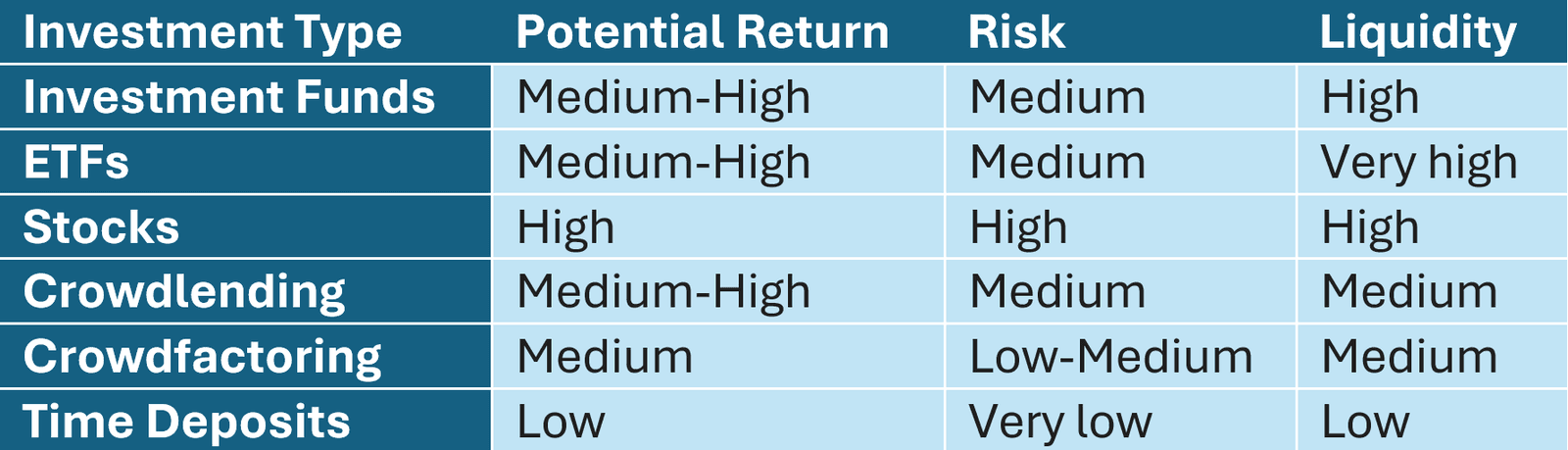
Each of these assets plays a different role in a portfolio. Deposits prioritize capital preservation, whereas mutual funds allow for immediate diversification. Stocks offer higher growth potential, but also greater volatility.
On the other hand, crowdlending and crowdfactoring allow direct investment in the real economy, providing a source of returns that is less dependent on the daily movements of financial markets.
Mutual funds: do they remain one of the most profitable options?
Despite the growth of alternative solutions, mutual funds continue to be one of the most efficient ways to invest for the medium and long term.
Both domestic and international active management underwent a strong thematic rotation in the first half of the year. The technology sector (focusing on artificial intelligence, high-performance semiconductors, and connectivity) and the energy infrastructure sector led gains.
The main advantage is simple: instead of investing in a single company, the investor holds a diversified portfolio composed of dozens or hundreds of assets.
This diversification reduces company-specific risk and allows investors to benefit from growth across different sectors and geographies.
Furthermore, management is handled by professional teams that continuously monitor the markets and adjust portfolios according to economic conditions.
According to the 2026 statistical reports from the Portuguese Association of Investment Funds, Pension Funds and Assets (APFIPP), domestic-managed securities investment funds (FIM) that led cumulative returns over the last 12 months stood out in the energy and emerging markets categories:
Montepio Euro Energy (Montepio Gestão de Ativos): A sector fund focused on energy transition and infrastructure, with an annual gain of 40.2%;
Caixa Ações Emergentes (Caixa Gestão de Ativos): Concentrated exposure to developing markets, with a return exceeding 37%;
Montepio Multi Gestão Mercados Emergentes (Montepio Gestão de Ativos): International multi-manager allocation, with returns above 30%;
Optimize PPR/OICVM Agressivo (Optimize Investment Partners): A retirement savings plan (PPR) with high exposure to global equities, accumulating a 25.8% annual return;
Caixa Ações Líderes Globais PPR/OICVM (Caixa Gestão de Ativos): A solution focused on large-cap multinationals with a 25.0% appreciation.
According to the CMVM (Portuguese Securities Market Commission), mutual funds remain one of the most widely used financial products by retail investors seeking to diversify their wealth.
💡 Analyst's Tip
Do not choose a fund simply because it was the most profitable over the last year. Also analyze the consistency of its results, management fees, risk level, and whether the fund aligns with your financial goals.
The growth of alternative investments
In recent years, Portuguese investors have begun looking beyond traditional financial products.
The increasing digitalization of the financial sector, combined with European regulation, has enabled the development of new investment forms that are also accessible to retail investors.
Among them are:
Private debt;
Fractional real estate investing;
Crowdfunding / Participatory financing.
Unlike exchange-listed assets, these solutions are often linked to the real economy, that is, the direct financing of businesses and productive projects.
This characteristic makes them particularly attractive to investors looking to diversify their portfolio and reduce reliance on financial markets.
According to the European Crowdfunding Network, in Portugal and across Europe, this market has consolidated its legal maturity under the framework of the European Crowdfunding Service Providers Regulation (Regulation EU 2020/1503), supervised nationally by the Portuguese Securities Market Commission (CMVM). This ensures a unified framework with high standards of transparency, conflict-of-interest mitigation, and credit risk monitoring.
Why is the real economy gaining more and more importance?
When you invest in stocks, returns depend largely on stock market performance. When you invest in assets linked to the real economy, the source of returns is different.
The investment is tied to funding businesses, growth projects, or working capital needs, allowing the investor to participate directly in economic activity.
This does not eliminate risk, but it adds a source of diversification that can help reduce the portfolio's correlation with traditional markets.
Time deposit or mutual fund: which is more profitable in 2026?
Is it more worthwhile to put money in a time deposit or invest in a mutual fund?
The answer depends on several factors, such as the investment timeframe, financial goals, and risk tolerance.
If the primary goal is to preserve capital for a short period and guarantee a known return from the outset, time deposits remain a valid solution.
On the other hand, those who intend to grow their wealth over the years tend to benefit more from mutual funds, which historically present higher growth potential, although they are subject to financial market fluctuations.
Portugal's macroeconomic metrics confirm that mutual funds are significantly more profitable in the medium and long term. While domestic time deposits yield an average gross annual nominal rate (TANB) of only 1.48% (with promotional options in the market reaching a maximum of 2.75%), these solutions do not cover the 3.1% inflation rate, resulting in a loss of real purchasing power. Mutual funds expose capital to the real growth of the economy and companies. Although subject to market fluctuations, they offer historically much higher returns and, since 2024, benefit from reduced IRS (personal income tax) rates on long-term capital gains.
The CMVM notes that the relationship between risk and return is one of the fundamental principles of investing: the higher the potential return, the higher the associated risk tends to be.
Therefore, the decision should never be based solely on the advertised interest rate.
It is equally important to analyze factors such as:
Liquidity;
Volatility;
Time horizon;
Diversification;
Taxation.
Comparison: time deposit vs. mutual fund vs. real economy
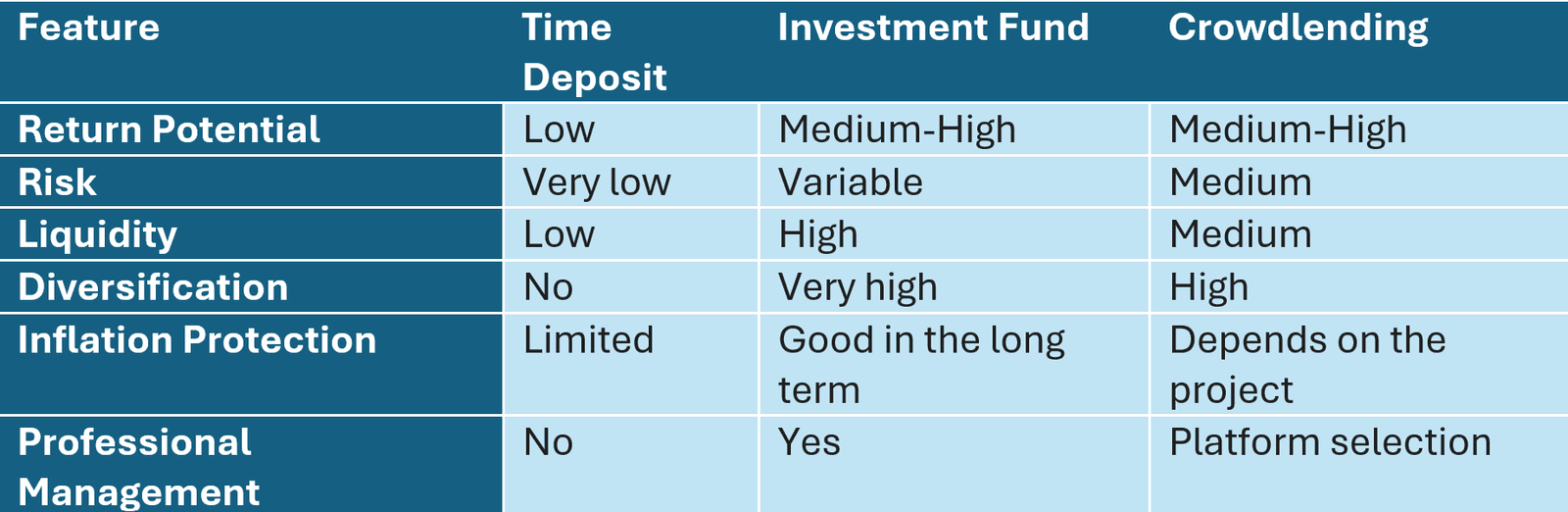
At first glance, a time deposit seems like the safest choice. However, that safety comes with an opportunity cost.
By locking up capital for several months or years, investors may miss out on more profitable opportunities. Furthermore, when the net return is lower than inflation, money continues to lose purchasing power despite an increasing account balance.
According to Banco de Portugal, rates offered on deposits improved with the ECB's key rate hikes, but began to stabilize as monetary policy entered a new phase. In practice, this means that many deposits have returned to offering modest yields, which are insufficient for those seeking to grow their wealth over the long term.
💡 Analyst's Tip
Before comparing financial products, compare real returns rather than just nominal returns. An investment yielding 3% per year may seem attractive, but if inflation is similar and taxes apply to gains, the effective return can be quite small.
Why are so many investors looking for alternatives to deposits?
For decades, time deposits were the main choice for Portuguese households. Ease of use, the guarantee provided by the Deposit Guarantee Fund (Fundo de Garantia de Depósitos, up to statutory limits), and low risk explain this preference.
However, the context has changed.
Today, many investors are looking for solutions that allow them to:
Increase wealth appreciation potential;
Diversify investments;
Reduce the impact of inflation;
Create additional income streams.
It is precisely in this context that mutual funds and real economy-linked assets have gained relevance.
Taxation also influences profitability
When choosing an investment, many investors focus exclusively on expected returns. However, the tax impact can significantly alter the final result.
In Portugal, income generated from mutual funds, deposits, bonds, or crowdfunding platforms can be subject to different tax rules.
Before investing, it is advisable to consult information provided by the Tax and Customs Authority (Autoridade Tributária e Aduaneira) or seek specialized advice to understand the tax treatment applicable to your specific case.
More important than chasing specific tax benefits is building a portfolio suited to your profile and time horizon.
📌 Did you know…?
Investments should be evaluated by their net return, that is, after considering costs, fees, taxes, and inflation. Two products with the same gross yield can generate significantly different results over the long term.
What is the most suitable investment for your profile?
One of the biggest misconceptions about investing is believing that there is a single ideal solution for everyone.
In reality, the best investment always depends on an individual's goals, experience, and ability to handle market fluctuations.
Conservative Profile: Primarily values safety and aims to minimize risk, favoring time deposits, money market funds, and short-term bond funds. Typically, these products feature lower volatility, though they also offer lower growth potential.
Moderate Profile: Those seeking a balance between safety and returns tend to combine different assets. A moderate portfolio may include global funds, ETFs, bonds, and real-economy investments. This diversification helps reduce the impact of potential drops in a single market.
Dynamic Profile: Investors with a long time horizon and higher risk tolerance usually favor assets with greater growth potential. It is common to find international equities, thematic funds, technology, artificial intelligence, emerging markets, and alternative assets in this type of portfolio. While volatility may be higher, appreciation potential tends to be greater over time.
How to invest in the real economy with Daskapital
Throughout this article, we have seen that finding the most profitable investments is no longer just about choosing between a time deposit or a mutual fund. The market has become more diversified, and today, retail investors have access to solutions that for many years were virtually reserved for banks, investment funds, and institutional investors.
One such solution is investing in the real economy through direct business financing. Instead of investing exclusively in exchange-listed assets, investors can allocate part of their portfolio to concrete business projects, contributing to economic growth while seeking potentially attractive returns.
It is in this context that Daskapital comes in.
What is Daskapital?
Daskapital is a European crowdfunding platform that connects investors with companies looking for financing to fund their growth projects.
The platform operates under European Regulation (EU) 2020/1503 on European crowdfunding service providers for business, and is authorized and supervised by the Portuguese Securities Market Commission (Comissão do Mercado de Valores Mobiliários - CMVM).
This regulatory framework establishes strict requirements regarding transparency, information disclosure, and investor protection, contributing to a safer and more uniform market across the entire European Union.
How does crowdlending work?
In the crowdlending model, investors lend capital to companies in exchange for receiving interest throughout the duration of the loan.
Unlike purchasing shares, the investor does not acquire an equity stake in the company.
Instead, they act as a lender, receiving periodic payments of principal and interest according to the defined schedule for each transaction.
Before investing, you can review detailed information about each opportunity, including:
Funding purpose;
Target amount;
Loan term;
Expected return rate;
Risk rating;
Repayment schedule.
This transparency allows investors to make more informed decisions and build a portfolio aligned with their risk profile.
Crowdfactoring: A complementary alternative
In this model, investment is directed toward funding commercial invoices issued by companies.
Because the maturity periods for these operations tend to be shorter, typically between one and three months, many investors use crowdfactoring to complement longer-term investments and increase capital turnover.
Just as with crowdlending, it is essential to carefully analyze the risk associated with each opportunity before investing.
💡 Analyst Tip
No single investment should account for your entire portfolio. Crowdlending can be an excellent addition to a diversified strategy, but it does not replace the importance of combining different asset classes.
How to integrate the real economy into a diversified portfolio?
One of the main advantages of investments linked to the real economy is that their performance depends on factors different from those that daily influence stock markets.
Although still subject to risk, these assets often show a lower correlation with traditional stocks or investment funds. For this reason, many investors choose to allocate their wealth across different asset classes.
An example of a diversified portfolio might include:
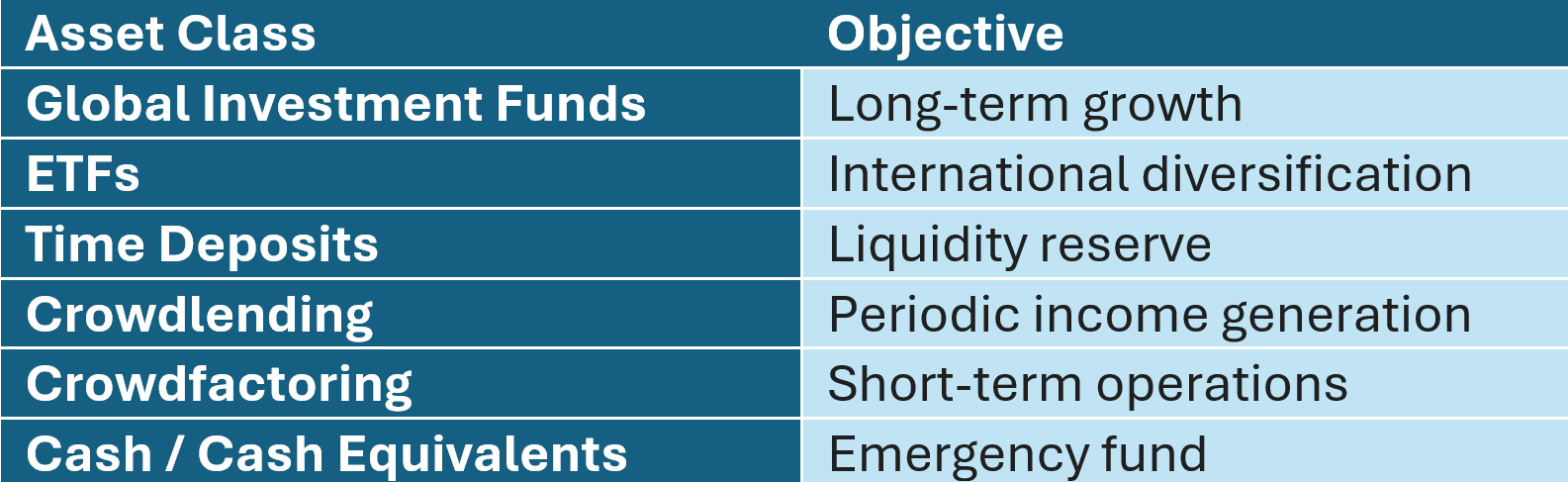
Naturally, this distribution must be adjusted to each investor's risk profile, financial goals, and time horizon.
Why is diversification still so important?
Diversifying isn't just about investing in multiple products; it means combining assets that may react differently to the same economic events.
When one asset class goes through a less favorable period, others can help cushion the impact of those losses on the portfolio.
This principle is widely recognized by entities such as the CMVM, ESMA, and the Bank of Portugal, which recommend diversification to retail investors as one of the primary risk management tools.
This is precisely why many investors today combine investment funds, ETFs, bonds, and assets linked to the real economy, aiming for a balance between growth, stability, and income generation.
Conclusion
Finding the most profitable investments in 2026 requires a different approach than what was sufficient a few years ago.
In a context shaped by inflation, shifting interest rates, and more volatile financial markets, returns no longer depend solely on picking a single financial product. Above all, they depend on the ability to build a diversified portfolio tailored to each investor's risk profile and objectives.
Investment funds remain one of the most effective tools for those seeking medium- and long-term growth, allowing exposure to sectors like artificial intelligence, healthcare, infrastructure, or cybersecurity.
At the same time, solutions tied to the real economy, such as crowdlending and crowdfactoring, offer new avenues for diversification and participating in corporate financing.
Rather than hunting for "the best investment," the real challenge lies in striking the right balance among risk, liquidity, profitability, and diversification.
At Daskapital, we believe investing should be an informed, transparent, and accessible process. That is why we provide thoroughly vetted opportunities and clear information to help every investor make conscious decisions aligned with their financial goals.

Frequently asked questions
Invoice Advance is a crowdfactoring solution for short-term financing that allows companies to anticipate the payment of invoices receivable, obtaining immediate liquidity. Invoice Advance is managed by Daskapital España S.L., a subsidiary of Das Kapital Lda.
In the Invoice Advance collaborative financing model, companies publish the credits they hold on their customers on the Daskapital platform, and investors compete with each other to purchase, at a discount, part or all of the invoice. Through an auction process, they define the amount they wish to invest and the minimum return they require, and companies will be financed by the group of investors demanding the lowest interest rate.
On the invoice due date, the debtors (the company's customers) pay the credit, returning the capital invested to the investors. The profit comes from the difference between the amount invested in the invoice seller and the amount received from the invoice payer, which corresponds to the discount.
Crowdfactoring is a form of collaborative financing in which companies can receive advance payment for receivables owed by their customers through online platforms such as Daskapital.
In this model, investors purchase invoices (partially or in full) at a discount (which translates into a rate of return), advancing their value to companies. This allows companies to quickly obtain the financing they need, while investors earn a financial return by acquiring the right to receive payment of the invoice amount (partial or full) on the due date.
Invoice Advance offers advantages for both investors and companies.
For investors, it allows them to diversify their portfolio with short-term investments and above-average returns, choosing the invoices in which to invest (and the consequent level of risk and maturity) and the minimum rate of return they require, with security and transparency guaranteed by Daskapital, which analyses and verifies the solvency of the payers of the invoices provided by the assignors.
For companies, it guarantees immediate liquidity without resorting to banks, allowing them to finance themselves at even lower interest rates if they are assigning credits on companies with lower risk than themselves, as the associated risk, as perceived by the investor, is that of the invoice debtor.
It can be used by companies as a way to balance the risk level and maturities of their accounts receivable.
Each financing request or investment opportunity is subject to a rigorous risk analysis by Daskapital before being made available on the platform, based on:
- Accounting, financial and commercial data provided by the promoters of the companies;
- Credit information from Iberinform (Atradius Credit and Surety), such as ratios, information on incidents, legal proceedings and other independent data;
- Analytical and statistical models (credit score and limit);
- Document verification and, in some cases, verification of the accuracy of the information provided, among other procedures.
Daskapital requires real and personal guarantees and only publishes projects that meet the minimum criteria for risk and fair profitability. All this information is disclosed and made available in each financing request or investment opportunity.
If you need further clarification, don't hesitate to get in touch with us at support@daskapital.eu.