In 2026, defining investment strategies in the stock market requires much more than selecting shares based on their recent returns. Benchmark indices such as the PSI enable investors to track the performance of some of the leading listed companies in Portugal, although they represent only a fraction of the range of securities traded on Euronext Lisbon.
For companies managing surplus cash and investors taking a professional approach, any decision should be based on clear objectives, a defined investment horizon and a rigorous risk assessment.
Efficiently managing these surpluses requires combining the analysis of listed companies with a diversification policy suited to liquidity needs and risk profile. Investing in shares may offer opportunities for capital appreciation and income, but it also involves volatility and the possibility of capital loss. The CMVM expressly identifies market, capital, credit, counterparty and liquidity risks among the risks to consider before investing.
For this reason, a structured strategy should combine fundamental analysis, technical analysis, diversification and risk management, while always distinguishing between capital available for investment and the resources required for the company’s day-to-day operations.
How does the stock market work?
To understand investment strategies on the stock market, it is important first to gain a general understanding of how a stock market works. Stock exchanges organise the trading of financial instruments, such as shares, enabling buyers and sellers to trade through the infrastructure and rules established for each market.
In Portugal, the main regulated share market is Euronext Lisbon, which forms part of the pan-European Euronext group. Trading takes place via Euronext’s technological infrastructure, enabling buy and sell orders to be processed electronically in accordance with the rules applicable to the market.
What Is Euronext Lisbon and how does it work?
To understand stock market investment strategies in Portugal, it is first important to understand how the Portuguese market operates.
Euronext Lisbon is the Portuguese financial market integrated into the pan-European Euronext group. Trading takes place through Euronext’s technological infrastructure, allowing buy and sell orders to be processed electronically in accordance with the rules applicable to the market.
Euronext has harmonised rules for its regulated markets, complemented by specific provisions applicable to each market. In Portugal, the supervision of financial instrument markets and their participants is the responsibility of the Portuguese Securities Market Commission (CMVM), within the scope of its powers under national and European legislation.
Settlement and other post-trade services associated with the Portuguese market are provided through the Euronext group’s infrastructure, including Euronext Securities Porto, formerly known as Interbolsa.
Although shares are traded through a common infrastructure, liquidity can vary significantly between companies. Trading volume, the number of market participants and the size of each company may influence how easily and at what price a position can be bought or sold.
Euronext Lisbon and the PSI Index: They are not the same thing
It is important to distinguish between the market and its main benchmark index.
The PSI is not the Portuguese stock exchange, but an index designed to reflect the performance of a group of shares traded on Euronext Lisbon, according to criteria defined by Euronext.
As of June 2026, the PSI comprised 16 companies: Altri, Banco Comercial Português, Corticeira Amorim, CTT, EDP, EDP Renováveis, Galp, Ibersol, Jerónimo Martins, Mota-Engil, NOS, REN, Semapa, Sonae, Teixeira Duarte and The Navigator Company.
The review carried out by Euronext in June 2026 did not result in any changes to the composition of the index. The PSI is reviewed quarterly in June, September and December, with a full annual review taking place in March.
Inclusion in the PSI does not depend solely on a company being listed on Euronext Lisbon. The selection process takes into account, amongst other criteria, the size of the company in terms of free-float-adjusted market capitalisation, the distribution of shares on the market and the liquidity of the security. According to the index rules, eligible companies are ranked on the basis of free-float market capitalisation and are subject to minimum liquidity and size criteria.
This means that a company may be listed on Euronext Lisbon without being included in the PSI. The PSI All-Share, for example, covers a broader universe of securities traded in Lisbon.
For an investor, this distinction is relevant: limiting analysis to PSI constituents may exclude smaller or less liquid companies that are also part of the Portuguese market.
💡Note on CMVM Regulation
The existence of a regulated and supervised market does not eliminate the risks associated with investing in shares. Decisions should take into account factors such as risk, investment horizon, liquidity, costs and diversification, considering each investor’s objectives and financial capacity.
Main investment strategies in the Stock Market
There is no single formula for building an investment strategy in the stock market. The appropriate approach depends on financial objectives, investment horizon and the ability to withstand losses or fluctuations in capital value.
Among the most widely used methodologies are fundamental analysis, which focuses on the business and its valuation, and technical analysis, which studies price behaviour and trading volume. The CFA Institute distinguishes the two approaches in this way: fundamental analysis uses information about the economy, industry and company to estimate the value of a security, while technical analysis primarily uses prices and volumes to study market movements.
Fundamental Analysis for the Long Term
Fundamental analysis seeks to assess a company’s economic and financial position and determine whether its share price is consistent with the business’s ability to generate earnings and cash flows. According to the CFA Institute, financial analysis combines information from financial statements, the business, the industry and the economic environment to assess a company’s performance, financial position and value.
When applying these investment strategies on Euronext Lisbon, indicators may include:
P/E Ratio (Price-to-Earnings Ratio): Compares a company’s share price with its earnings per share. A high P/E ratio may reflect growth expectations, but it should be interpreted in comparison with similar companies, the company’s own historical levels and the outlook for its industry. The CFA Institute includes price-to-earnings among the multiples used in equity valuation and highlights the importance of comparing it with fundamentals and comparable companies.
EV/EBITDA: Compares enterprise value with EBITDA and facilitates certain comparisons between companies with different financing structures.
Dividend Yield: Compares the dividend paid per share with the share price. A high yield does not, on its own, mean that a share is undervalued or represents a better investment opportunity. Dividend yield is used as a valuation indicator, but also depends on expectations for dividend growth and the return required by the investor.
Net Debt/EBITDA: Helps assess the level of indebtedness relative to the company’s operating earnings capacity.
Free Cash Flow (FCF): Helps determine how much cash remains available after the investments required to maintain and develop the business.
The value of fundamental analysis lies in interpreting different indicators together, rather than relying on a single ratio to automatically determine whether a share should be bought or sold.
Consider the diversity within the PSI itself. Analysing an energy company such as Galp, a food retail group such as Jerónimo Martins, or an industrial company such as Corticeira Amorim requires evaluating different economic and operational factors. All three were included in the official PSI composition published by Euronext in 2026.
All three are part of the PSI in 2026, but they are exposed to different markets, economic cycles and risk factors. This is precisely why two securities belonging to the same index may require fundamentally different analyses.
Technical Analysis and Market Timing
While fundamental analysis seeks to understand the business and its valuation, technical analysis focuses on how the share behaves in the market.
This approach uses historical prices and trading volumes to identify trends and potential entry or exit levels. Some of the most widely used tools include moving averages, support and resistance levels, momentum indicators such as the RSI*, and trading volume.
¹ RSI (Relative Strength Index): a technical momentum indicator that measures the speed and magnitude of recent price changes, typically on a scale from 0 to 100, and is used to assess the strength of market movements.
For example, if a share breaks through a resistance level accompanied by a significant increase in volume, a technical analyst may consider the move relevant to their analysis. A breakout accompanied by low volume may call for a more cautious interpretation. Research published in the Financial Analysts Journal has identified relationships between trading volume and the persistence or reversal of price movements, although these findings do not guarantee future performance.
Liquidity is particularly important for less actively traded securities. A large order may have a greater impact on the price, and the difference between the expected price and the actual execution price may be higher.
Technical analysis cannot, however, predict future share price movements with certainty. Indicators help structure scenarios and decisions, but they do not guarantee exact entry or exit points.
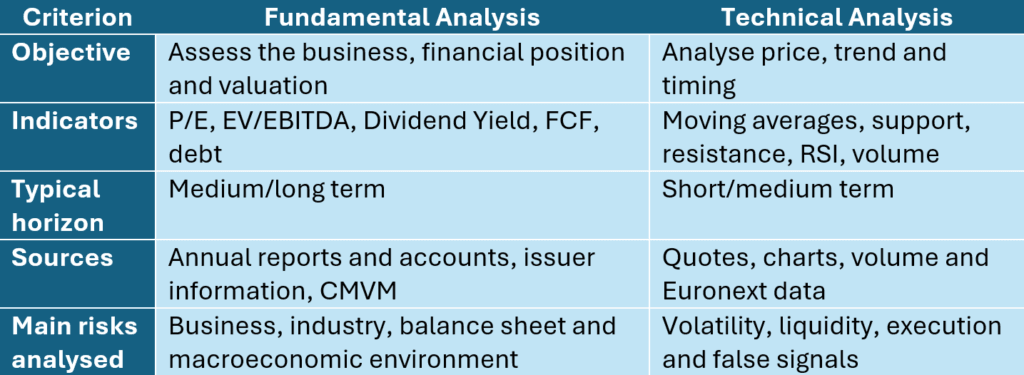
The distinction between fundamental and technical analysis presented in the table follows the approach used by the CFA Institute, which distinguishes the company and economic information used in fundamental analysis from the price and volume data used in technical analysis.
Growth vs. Value Strategy
Another way of structuring an investment strategy in the stock market is through the distinction between Growth and Value.
Growth strategies seek companies expected to achieve significant growth in revenue, earnings or cash flows. These expectations may justify higher valuation multiples, but they can also make the share price sensitive to results that fall below expectations.
Value strategies, in turn, seek companies whose share price may appear low relative to their fundamentals, assets, earnings or cash-generating capacity.
The MSCI methodology for Value and Growth factors shows that these classifications do not depend on a single variable: Value considers, among other factors, book-to-price, forward earnings-to-price and dividend yield, while Growth considers measures of expected and historical earnings and sales growth.
Neither classification automatically implies higher returns, greater stability or lower risk. A company considered value may continue to lose value, including when structural problems are already being reflected in the market price, while a growth company may fail to meet the expectations embedded in its valuation.
Therefore, the choice between Growth and Value should take into account the economic cycle, interest rates, industry, financial structure, competitive position and the specific valuation of each company.
Risk Management and Portfolio Diversification
Choosing shares is only one part of the strategy. How capital is distributed across different investments is equally relevant to the overall risk of the portfolio.
Concentration risk arises when an excessive proportion of capital is exposed to a single company, industry, market or asset type. Diversification can help reduce this concentration by distributing capital across investments with different characteristics. The CMVM expressly recommends that investors diversify their choices, while the SEC defines diversification as spreading investments across different assets to reduce overall portfolio risk.
However, diversification reduces certain risks but does not eliminate them. Even diversified portfolios remain exposed to market risk and to the specific characteristics of the asset classes in which they invest.
Mitigating Volatility
A risk management policy may incorporate different mechanisms.
Exposure limits: Setting a maximum percentage of the portfolio per company or sector can reduce the impact of an adverse event affecting a single position.
Stop-Loss Orders: These can be used to establish predetermined exit levels. However, they do not guarantee protection against losses. During periods of high volatility or sudden market movements, the actual execution price may differ from the specified level. FINRA and the SEC specifically warn that the stop price acts as a trigger but is not a guaranteed execution price, meaning significant differences may occur in fast-moving or volatile markets.
Sector diversification: Distributing capital among companies exposed to different industries and economic cycles can reduce portfolio concentration.
Liquidity monitoring: Assessing trading volume and the characteristics of a security helps determine how easily a position may be unwound without having a disproportionate impact on its price. Both the CFA Institute and Investor.gov identify liquidity, order size and price impact as relevant factors in trade execution.
💡Expert Advice
Before investing corporate surplus funds, it is important to separate the capital needed to finance business operations and maintain an adequate liquidity reserve. Only resources that are not required for foreseeable operational needs should be considered for investment strategies, taking into account the investment horizon and the company’s ability to withstand volatility and losses.
Beyond Investing in Shares
Diversification can begin by spreading your investment across shares in different companies, but it is not limited to diversification across securities.
During periods of economic or financial instability, securities belonging to different sectors may decline simultaneously. For this reason, a broader strategy may combine assets with different sources of return, investment horizons and risk factors.
In addition to investing in shares, fixed-income instruments, money market products or alternative forms of business financing may be considered, including crowdlending and crowdfactoring.
These instruments have different characteristics from listed equities, but this does not mean they are automatically “uncorrelated” with the stock market or free from risk.
An alternative investment may involve credit, default, delay, concentration and liquidity risk. The absence of a daily market price does not imply the absence of economic risk. In the case of Daskapital crowdfunding, the platform’s own documentation provides for the disclosure of information such as the risk category, term, remuneration and any guarantees associated with each offer.
Digital Solutions and Alternative Financing with Daskapital
Diversification may also include investments directly linked to financing the real economy.
At Daskapital, investors can access opportunities with different characteristics and time horizons through Crowdlending and Crowdfactoring, selecting transactions according to their investment objectives and risk appetite.
Crowdlending
Crowdlending is a loan-based crowdfunding solution designed to finance business expansion projects, asset acquisitions or certain community projects.
Before a project is made available on the platform, Daskapital analyses the information provided by the project owner and independent financial sources, assesses the risk of the transaction and provides investors with relevant information, including a risk rating.
Once approved, the project is published and an auction begins, during which investors choose the projects in which they wish to participate, the amount they want to invest and the minimum interest rate they require.
During the term of the loan, the project owner makes the periodic payments established under the terms of the transaction.
Crowdfactoring
Crowdfactoring is aimed at short-term working capital and cash-flow requirements.
Companies can accelerate the collection of accounts receivable by selling invoices. The payer validates the invoice and, after the transaction has been assessed, investors may submit offers to acquire part or all of the receivable at a discount.
On the maturity date, payment of the receivable enables the invested capital to be repaid in accordance with the terms of the transaction, with the return corresponding to the difference between the price paid to acquire the receivable and the amount received at maturity.
For companies, this solution makes it possible to turn accounts receivable into liquidity, while Crowdlending is aimed at medium-term financing needs.

Conclusion
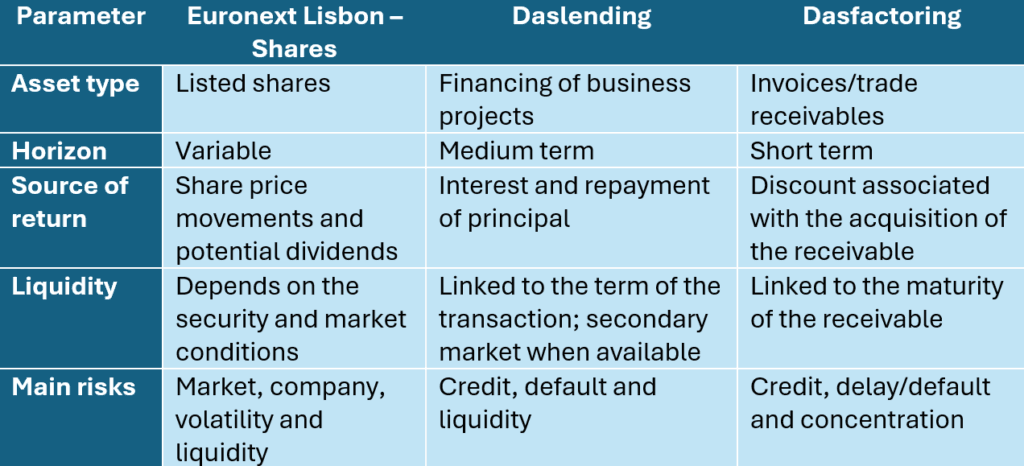
Building robust investment strategies in the stock market is not about searching for a single miracle stock, but about following a rigorous process: understanding the structure of the market, analysing company fundamentals, assessing trading conditions and defining a level of risk that is compatible with financial objectives.
For companies, the priority should be to safeguard the liquidity required for business operations. Treasury management should clearly distinguish operating capital from surplus funds that are genuinely available for investment.
From that starting point, combining different companies, sectors, investment horizons and sources of return can help reduce concentration. Alternative solutions such as crowdlending or crowdfactoring may form part of this analysis, provided that the specific risks of each transaction are taken into account.
Diversification does not eliminate risk. In crowdfunding, there is a possibility of partial or total loss of the invested capital and liquidity may be limited, meaning that each opportunity should be assessed according to the investor’s profile and objectives.

Frequently asked questions
Invoice Advance is a crowdfactoring solution for short-term financing that allows companies to anticipate the payment of invoices receivable, obtaining immediate liquidity. Invoice Advance is managed by Daskapital España S.L., a subsidiary of Das Kapital Lda.
In the Invoice Advance collaborative financing model, companies publish the credits they hold on their customers on the Daskapital platform, and investors compete with each other to purchase, at a discount, part or all of the invoice. Through an auction process, they define the amount they wish to invest and the minimum return they require, and companies will be financed by the group of investors demanding the lowest interest rate.
On the invoice due date, the debtors (the company's customers) pay the credit, returning the capital invested to the investors. The profit comes from the difference between the amount invested in the invoice seller and the amount received from the invoice payer, which corresponds to the discount.
Crowdfactoring is a form of collaborative financing in which companies can receive advance payment for receivables owed by their customers through online platforms such as Daskapital.
In this model, investors purchase invoices (partially or in full) at a discount (which translates into a rate of return), advancing their value to companies. This allows companies to quickly obtain the financing they need, while investors earn a financial return by acquiring the right to receive payment of the invoice amount (partial or full) on the due date.
Invoice Advance offers advantages for both investors and companies.
For investors, it allows them to diversify their portfolio with short-term investments and above-average returns, choosing the invoices in which to invest (and the consequent level of risk and maturity) and the minimum rate of return they require, with security and transparency guaranteed by Daskapital, which analyses and verifies the solvency of the payers of the invoices provided by the assignors.
For companies, it guarantees immediate liquidity without resorting to banks, allowing them to finance themselves at even lower interest rates if they are assigning credits on companies with lower risk than themselves, as the associated risk, as perceived by the investor, is that of the invoice debtor.
It can be used by companies as a way to balance the risk level and maturities of their accounts receivable.
Each financing request or investment opportunity is subject to a rigorous risk analysis by Daskapital before being made available on the platform, based on:
- Accounting, financial and commercial data provided by the promoters of the companies;
- Credit information from Iberinform (Atradius Credit and Surety), such as ratios, information on incidents, legal proceedings and other independent data;
- Analytical and statistical models (credit score and limit);
- Document verification and, in some cases, verification of the accuracy of the information provided, among other procedures.
Daskapital requires real and personal guarantees and only publishes projects that meet the minimum criteria for risk and fair profitability. All this information is disclosed and made available in each financing request or investment opportunity.
If you need further clarification, don't hesitate to get in touch with us at support@daskapital.eu.