
To grow your wealth, you don’t need luck or a massive initial investment: the reality is much more mathematical and accessible. The secret of successful investors lies not only in “how much” they invest, but in “how” they do it. Compound interest is often cited as one of the most effective ways to grow your money over time. However, contrary to what many people think, compound interest is not a financial product, but rather a mathematical mechanism based on the capitalization of interest.
In this comprehensive guide to investing in compound interest in Portugal, we’ll explore everything from the theoretical foundations to practical applications in the Portuguese market, analyzing where to find the best rates and how collaborative investment tools, such as Daskapital, can exponentially accelerate your returns through strategic reinvestment.
Compound interest: What is it, and why is it beneficial?
Before looking at the latest trends, it’s important to understand the classic options that continue to shape the market:
A clear definition of compound interest
In simple terms, compound interest is “interest on interest”. Unlike the simple interest model, where returns are calculated only on the initial amount, in the compound interest model, the interest earned in each period is added to the principal. In the following period, the interest rate is applied to this new total, creating a snowball effect of growth.
What is interest compounding?
Interest capitalization is the accounting and financial process of adding the income generated to the principal investment. This is what allows for the accumulation of compound interest. According to the transparency standards of the CMVM (Portuguese Securities Market Commission) detailed in its Investor Guide, without compounding - that is, if you withdraw the interest as soon as it is credited to your account - your money grows linearly and never reaches its maximum potential.
According to the Bank of Portugal, many financial products such as deposits or funds may include capitalization mechanisms, but not all do so automatically.
Simple interest vs. compound interest: what is the fundamental difference?
While simple interest is predictable and static, compound interest is dynamic.
Linear growth vs. exponential growth
With simple interest, growth is linear. If you invest €1,000 at 5% per year, you earn €50 every year. After 10 years, you have €1,500.
With compound interest, growth is exponential. In the first year, you earn €50, but in the second year, you earn 5% on €1,050 (€52.50), and so on.
To illustrate, here is the growth of €10,000 at 10% per year (before taxes):
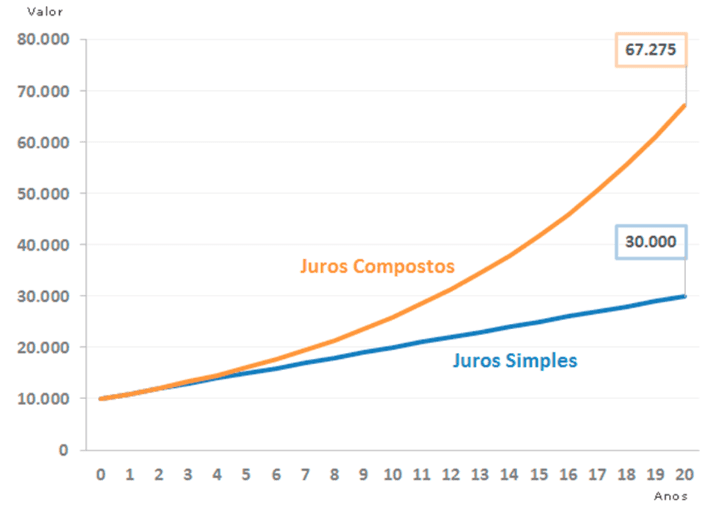
The difference may seem small in the first five years, but it becomes increasingly significant as time goes on. This is the effect that the European Central Bank (ECB) monitors when analyzing the accumulation of household wealth in the Eurozone.
How do you calculate compound interest?
Mastering the compound interest formula allows you to make realistic projections for your financial future.
The mathematical formula
The standard formula for calculating the final amount (M) is:
M = C × (1+i)^t
Where:
M: Final amount (principal + interest).
C: Initial principal invested.
i: Interest rate per period (as a decimal, e.g., 0.05 for 5%).
t: Total duration of the investment.
Real-life simulation with €1,000
Imagine you decide to invest €1,000 in a compound interest account at an annual rate of 8% (a common rate for crowdlending projects on Daskapital) for 10 years:
M = 1000(1 + 0,08)^10
M = 1000(2,158)
M = 2.158,92€
With simple interest, you would have only €1,800. Compounding gave you a “bonus” of nearly €359 without any extra effort.
Annual compounding vs. monthly compounding
The frequency with which interest is added to the principal affects the outcome. If interest is compounded monthly (as is the case with many crowdfunding projects), the effect is even more pronounced, since interest begins to generate “interest on interest” as early as the second month, rather than just in the second year.
Expert tip: Use an online return calculator or an Excel spreadsheet to test different scenarios. Small adjustments to the rate or frequency can make all the difference.
What factors determine the power of capitalization?
To maximize your return when investing in compound interest, you should focus on these three variables:
Interest rates: A 1% increase in the rate may seem small today, but after 20 years it can amount to tens of thousands of euros in difference.
Compounding frequency: The more frequent the compounding (daily > monthly > annual), the higher the final return.
Reinvestment: This is where many people fall short. For compound interest to work, you cannot “spend” the earnings; you must reinvest them immediately.
What is the current state of the capital market in Portugal?
The Portuguese market has specific tax and supply characteristics that influence strategy.
Term deposits and interest rates
Term deposits are the Portuguese people’s favorite product because of their security. However, according to statistical data from the Bank of Portugal, interest rates on term deposits have been at historically low levels. Furthermore, many term deposits in Portugal do not allow for automatic compounding (interest is credited to the checking account), which interrupts the cycle of compound interest if the investor does not manually reinvest it elsewhere. Many renewable deposits adjust the interest rate downward, making the product less attractive.
Accumulating funds and ETFs
For those looking for compound interest opportunities in the capital markets, accumulation-type ETFs (Exchange-Traded Funds) are ideal. In Portugal, the tax treatment of investments favors these products, as there is no withholding tax. The tax is calculated on the income tax return the following year, which allows more time for capital appreciation, and these gains can be rolled over.
Impact of inflation on real returns
According to the INE (National Institute of Statistics) in its Consumer Price Index, inflation erodes the value of money. If your investment yields 3% and inflation is 3%, your real return is zero. For compound interest to function as a wealth-builder, the rate must be significantly higher than inflation.

Common mistakes to avoid with compound interest
When analyzing investor behavior, the CMVM frequently warns of misperceptions:
Thinking that any investment generates capital growth: If the product pays interest and that interest sits idle in a checking account, there is no compound interest.
Not reinvesting interest: Using monthly returns for spending stops the “snowball effect.”
Underestimating the importance of time: Waiting for the “perfect moment” or for having “a lot of money” to get started. Time is more valuable than the initial amount.
How can I invest in compound interest in Portugal?
To put theory into practice, follow this strategic roadmap:
Set your goal and time horizon: Compound interest really shines over periods longer than 5 or 10 years.
Choose instruments with automatic compounding: Accumulating ETFs or Retirement Savings Plans (PPR).
Use Collaborative Investing (Crowdlending): Platforms like Daskapital allow you to reinvest the monthly interest received from business loans into new projects, creating a highly efficient manual compounding strategy.
Monitor and Adjust: Reassess your portfolio annually to ensure rates remain competitive. Use the return simulator on the Daskapital website to adjust your expectations.
Crowdfunding: The Daskapital Solution
Crowdlending offers different - and sometimes higher - rates of return. Daskapital, operating under the European Crowdfunding Regulation (EU) 2020/1503, provides specific tools:
How does daslending allow you to reinvest periodic interest? With Daslending, investors receive monthly payments (principal + interest). Instead of letting that money sit idle, the platform allows you to reinvest those earnings in new projects immediately. By doing this every month, you increase the frequency of compounding.
How does dasfactoring allow you to accelerate compounding? Dasfactoring focuses on short cycles (invoice factoring). By investing in short-term invoices and since interest is paid upfront, the capital returns to your account faster and can be immediately reinvested, allowing for more reinvestment cycles in the same year.
How can you accelerate the growth of compound interest?
Reinvest immediately: Don’t let your money sit idle in your account. At Daskapital, as soon as you receive payment for a project, reinvest it in another one.
Increase your investments regularly: Combine the power of compound interest with monthly contributions.
Invest in short-term options: Factoring allows your capital to “work” more often throughout the year.
Compound interest: Are you ready to take the first step?
Ready to put your interest to work? Explore the peer-to-peer lending opportunities at Daskapital and start building your exponential future today.
Frequently asked questions
Invoice Advance is a crowdfactoring solution for short-term financing that allows companies to anticipate the payment of invoices receivable, obtaining immediate liquidity. Invoice Advance is managed by Daskapital España S.L., a subsidiary of Das Kapital Lda.
In the Invoice Advance collaborative financing model, companies publish the credits they hold on their customers on the Daskapital platform, and investors compete with each other to purchase, at a discount, part or all of the invoice. Through an auction process, they define the amount they wish to invest and the minimum return they require, and companies will be financed by the group of investors demanding the lowest interest rate.
On the invoice due date, the debtors (the company's customers) pay the credit, returning the capital invested to the investors. The profit comes from the difference between the amount invested in the invoice seller and the amount received from the invoice payer, which corresponds to the discount.
Crowdfactoring is a form of collaborative financing in which companies can receive advance payment for receivables owed by their customers through online platforms such as Daskapital.
In this model, investors purchase invoices (partially or in full) at a discount (which translates into a rate of return), advancing their value to companies. This allows companies to quickly obtain the financing they need, while investors earn a financial return by acquiring the right to receive payment of the invoice amount (partial or full) on the due date.
Invoice Advance offers advantages for both investors and companies.
For investors, it allows them to diversify their portfolio with short-term investments and above-average returns, choosing the invoices in which to invest (and the consequent level of risk and maturity) and the minimum rate of return they require, with security and transparency guaranteed by Daskapital, which analyses and verifies the solvency of the payers of the invoices provided by the assignors.
For companies, it guarantees immediate liquidity without resorting to banks, allowing them to finance themselves at even lower interest rates if they are assigning credits on companies with lower risk than themselves, as the associated risk, as perceived by the investor, is that of the invoice debtor.
It can be used by companies as a way to balance the risk level and maturities of their accounts receivable.
Each financing request or investment opportunity is subject to a rigorous risk analysis by Daskapital before being made available on the platform, based on:
- Accounting, financial and commercial data provided by the promoters of the companies;
- Credit information from Iberinform (Atradius Credit and Surety), such as ratios, information on incidents, legal proceedings and other independent data;
- Analytical and statistical models (credit score and limit);
- Document verification and, in some cases, verification of the accuracy of the information provided, among other procedures.
Daskapital requires real and personal guarantees and only publishes projects that meet the minimum criteria for risk and fair profitability. All this information is disclosed and made available in each financing request or investment opportunity.
If you need further clarification, don't hesitate to get in touch with us at support@daskapital.eu.