
The landscape of corporate financing in Portugal in 2026 is undergoing a profound structural shift. Historically, the Portuguese business sector, comprising more than 99% small and medium-sized enterprises (SMEs), has always relied on the traditional banking channel to manage its liquidity, finance working capital, and execute expansion plans. However, macroeconomic volatility and the consolidation of the financial technology (fintech) ecosystem have made alternative financing an indispensable pillar of corporate resilience in 2026.
Today, companies looking to grow no longer rely exclusively on bank loans. Fintech platforms, crowdlending, digital factoring, and other alternative financing instruments are transforming the way capital flows into the real economy.
According to reports published by the Bank of Portugal, although the use of publicly guaranteed credit lines remained a significant component of SME financing in 2025 (accounting for approximately 27% of the total amount granted to small businesses), the market has seen a gradual shift toward disintermediated digital mechanisms, such as crowdlending and crowdfactoring. This transition is being greatly accelerated by the need for agility, given that traditional bureaucratic channels often cannot keep up with the speed of response required by the digital economy.
In this new paradigm, regulated crowdfunding platforms, such as Daskapital, play a critical role. By establishing a direct and transparent link between investors seeking to grow their capital and companies in need of liquidity, these platforms democratize access to capital.
In this article, you’ll learn:
What alternative financing is;
What solutions are currently available;
Competitive advantages;
When it might make more sense than traditional banking.
What is alternative financing?
Alternative financing refers to capital-raising mechanisms that operate outside traditional banking institutions. It is a broad concept that extends companies’ financial architecture far beyond the classic term loan, encompassing the advance of trade receivables, the issuance of disintermediated debt, and the opening of capital to collaborative networks of investors.
In practice, it allows companies to access financing through digital platforms, private investors, or specialized structures that use technology to accelerate analysis, decision-making, and execution.
Definition of alternative financing
Alternative business financing represents the disintermediation of the credit system. Instead of the conventional banking model, where the institution takes in deposits, assumes credit risk on its own balance sheet, and unilaterally decides on the granting of funds, non-bank financing solutions use technology to directly connect those with surplus capital (private or institutional investors) to those in need of financing.
As detailed on the IAPMEI information portal, these tools operate primarily through digital ecosystems that reduce overhead costs and eliminate bureaucratic red tape. Online platforms assess risk based on real-time transactional data and provide a transparent marketplace. Companies know all interest rates and associated costs in advance, with no hidden fees or the banking reciprocity requirements that affect the effective cost of traditional credit.
Why are financial alternatives emerging?
The growth of these solutions in Portugal is not a cyclical phenomenon, but rather a response to market failures and structural technological transformations. Three catalysts can be identified in 2025:
Bank Lending Criteria
The Bank Lending Survey shows that lending conditions for SMEs tend to become more restrictive in volatile economic environments.
This is due to:
Greater documentation requirements;
Strengthened risk analysis;
Greater sectoral sensitivity;
Increased need for collateral.
Operational Concentration and Limitations of the Banking Pool
The Portuguese financial market is characterized by a very high level of traditional banking penetration, where credit supply is concentrated among a small number of large deposit-taking institutions. This lack of flexibility and the homogeneity of risk criteria create barriers for companies with intangible assets or rapid growth profiles that require more flexible financial solutions.
Technological Innovation
The development of fintech has enabled the use of risk analysis models based on Artificial Intelligence and Open Banking. By instantly analyzing cash flows, signed contracts, and billing patterns, these platforms can quickly determine a company’s viability and repayment capacity, surpassing the static methods of traditional banking.
Change in Investor Profile
Investors are increasingly seeking exposure to the real economy and opportunities with higher potential returns than traditional instruments.
The growth of decentralized investing reflects this structural shift in the European market.
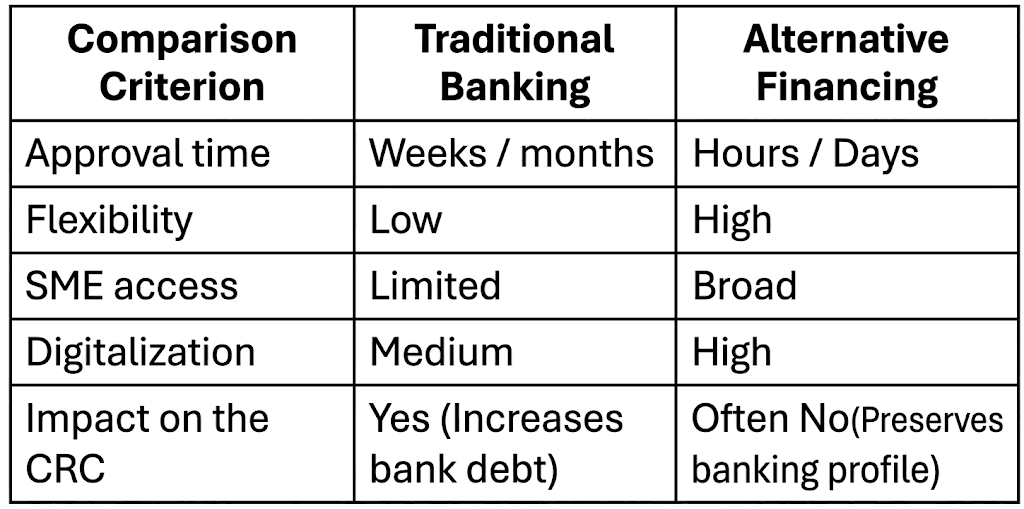
Traditional Financing vs. Alternative Financing
How Traditional Bank Financing Works
The traditional banking model is based on financial intermediation—banks accept deposits and extend credit after conducting a risk assessment.
In addition, banking transactions are reported to CIRBE (the Bank of Portugal’s Credit Information Center), which affects a company’s future borrowing capacity.
Although it is a solid and regulated model, it may have limitations for companies that:
Need quick liquidity;
Do not have sufficient collateral;
Are experiencing rapid growth;
Operate in more innovative sectors.
How does alternative financing work?
Alternative financing focuses on digitizing and decentralizing access to capital.
Instead of relying exclusively on a bank, a company can obtain financing through:
Private investors;
Digital platforms;
Specialized funds;
Investor communities.
The goal is to reduce friction, speed up processes, and expand access to capital.
Key Alternative Financing Options for Businesses
In Portugal, the alternative business financing market has evolved into well-defined market segments, offering solutions for both short-term needs and strategic capital investments.
1. Crowdlending
Crowdlending is a collective lending model between investors and companies via online platforms. It is a collective lending model where a company raises capital directly from private and institutional investors through a regulated electronic platform.
In this model:
The company requests financing;
The project is posted on a platform;
Multiple investors collectively finance the operation.
According to the CMVM, collaborative financing in Portugal has been growing, driven by digitalization and European regulations.
The main advantages of crowdlending include:
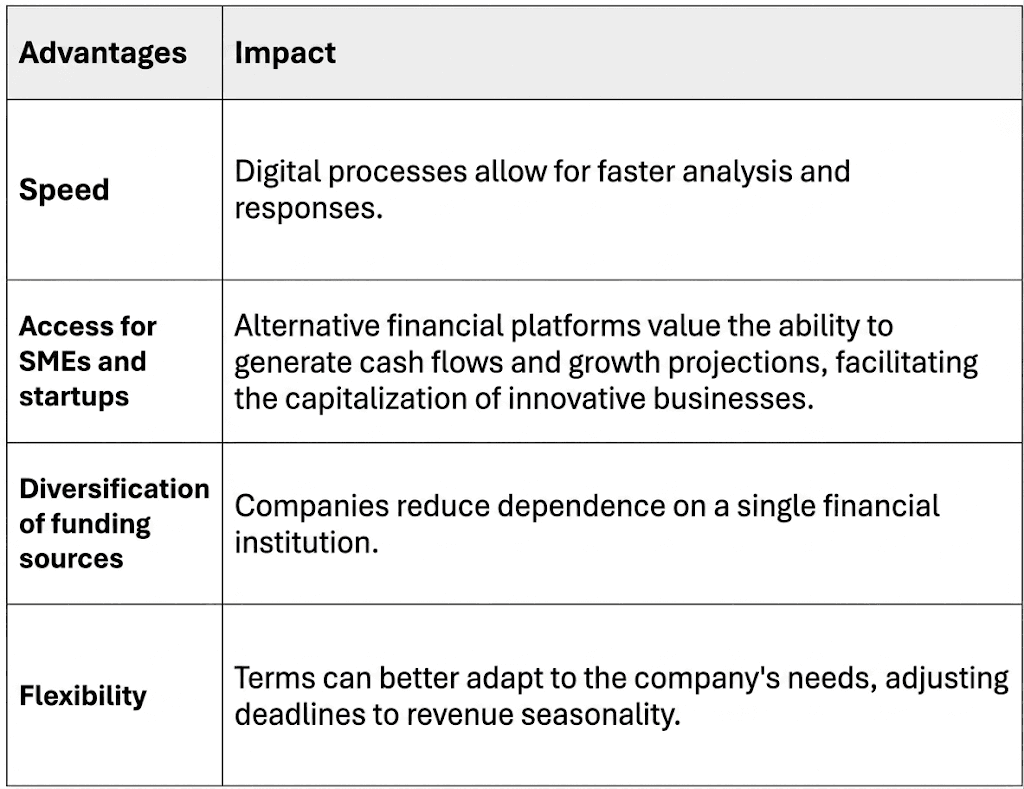
Speed;
Digital process;
Diversification of investors;
Transparent terms.
Crowdlending is particularly advantageous for established SMEs that need to make quick investments without diluting equity and with flexible repayment terms.
2. Crowdfunding
Crowdfunding is based on the collective raising of capital from multiple participants.
Crowdfunding takes various forms in the domestic market, all of which are regulated and supervised in accordance with the guidelines and regulations issued by the CMVM (Portuguese Securities Market Commission):
Equity crowdfunding - Investors become shareholders in the company, injecting funds in exchange for a direct equity stake. This is the solution for startups and technology-based companies that have high scalability potential but do not wish to bear the burden of fixed interest rates during the initial stages of revenue generation.
Reward-based crowdfunding - Participants fund projects in exchange for products, services, or exclusive benefits. Focused on market validation and pre-launches. Investors fund the development of a project or product through advance payment for it. Major global platforms, such as Kickstarter or Indiegogo, are widely used by Portuguese entrepreneurs to fund initial production without financial costs.
According to the European Crowdfunding Network, crowdfunding has become an important tool for startups and for validating the market for new products.
3. Factoring and invoice discounting
Factoring allows companies to receive payment for invoices in advance, improving liquidity and cash flow.
According to the Intrum European Payment Report, late payments remain one of the biggest financial challenges for European SMEs.
Factoring is particularly useful for:
Improving cash flow;
Reducing financial pressure;
Financing day-to-day operations.
According to the Payment Behavior Barometer published and analyzed by Informa, the reality of payment terms in Portugal remains highly concerning for the business community: only 20% of companies meet the payment terms agreed upon with their suppliers. Non-compliance is even more severe among large companies, where only 4% settle their obligations on time.
Given this scenario, invoice factoring through digital platforms offers immediate liquidity, whereby companies assign the rights to receive payment on an invoice issued to a creditworthy customer to a community of investors.
When conducted as non-recourse factoring, the official guidelines of the Bank of Portugal stipulate that these transactions are excluded from the centralized risk information reporting process, which protects the organization’s banking profile.
4. Venture Capital
Venture capital and private equity funds invest directly in companies with growth potential.
According to Invest Europe, investment in European SMEs through private equity continues to grow, particularly in technology and innovation sectors.
In addition to capital, these investors can provide:
Strategic expertise;
Support for expansion;
A network of contacts.
For high-growth structural projects, alternative financing includes private equity channels:
Business Angels: Individual investors who contribute capital and sector-specific knowledge (smart money) during the seed stage.
Venture Capital and Private Equity: Specialized firms that take minority or majority stakes to drive international expansion or corporate reorganizations.
The Role of Fintech Platforms
Fintech platforms have become fundamental to the modern financial ecosystem, serving as the technological and regulatory drivers of banking disintermediation and ensuring the transparency and security of the entire financial flow.
Platforms such as Daskapital enable:
Connecting companies and investors;
Automate processes;
Facilitate risk analysis;
Create business investment opportunities.
According to AICEP, the Portuguese fintech ecosystem has seen remarkable growth, with the amount invested exceeding 1.1 billion euros.
Advantages of financial alternatives
When to choose a financial alternative
The introduction of these tools must meet specific strategic criteria related to the company’s financial management:
Companies with Banking Pool Restrictions
Even highly stable and profitable businesses may face credit rejections due to sector-specific risk concentration limits established internally by commercial banks.
Phases of Expansion and Accelerated Growth
Projects requiring immediate investments for hiring teams, purchasing inventory, or rapid internationalization. Crowdlending focuses on the future viability of the business plan.
Cash Flow Management and Payment Term Mismatches
Given the reality in Portugal, where 80% of companies miss contractual payment deadlines, invoice factoring (crowdfactoring) has emerged as the ideal tool to address occasional liquidity shortfalls without worsening the company’s debt ratios in the CRC.
Innovative Projects
Startups and digital models may find greater flexibility on alternative platforms.
The Future of Alternative Financing in Portugal
The Portuguese fintech sector continues to grow, and European regulations have brought greater stability and professionalism to the market, boosting confidence among companies and investors.
According to the European Commission, financial digitization will continue to play a central role in the future of access to business financing. All signs point to models such as crowdlending, crowdfunding, and digital financing continuing to gain relevance in the coming years.
Alternative financing is no longer just a secondary option.
Today, it represents a strategic solution that complements traditional banking, allowing companies to access capital more quickly, flexibly, and digitally.
Models such as crowdlending, crowdfunding, and fintech platforms are transforming access to financing in Portugal and across Europe.
For Portuguese companies, the challenge is no longer just finding financing - it is knowing how to choose the most appropriate solution for each stage of growth. Integrating alternative financing channels into the business’s financial architecture is an essential step to mitigate credit risks, offset the impacts of late payments, and ensure the company grows at the pace demanded by the global economy.
Explore new ways to finance your business or invest in real projects through crowdlending.
Frequently Asked Questions
Invoice Advance is a crowdfactoring solution for short-term financing that allows companies to anticipate the payment of invoices receivable, obtaining immediate liquidity. Invoice Advance is managed by Daskapital España S.L., a subsidiary of Das Kapital Lda.
In the Invoice Advance collaborative financing model, companies publish the credits they hold on their customers on the Daskapital platform, and investors compete with each other to purchase, at a discount, part or all of the invoice. Through an auction process, they define the amount they wish to invest and the minimum return they require, and companies will be financed by the group of investors demanding the lowest interest rate.
On the invoice due date, the debtors (the company's customers) pay the credit, returning the capital invested to the investors. The profit comes from the difference between the amount invested in the invoice seller and the amount received from the invoice payer, which corresponds to the discount.
Crowdfactoring is a form of collaborative financing in which companies can receive advance payment for receivables owed by their customers through online platforms such as Daskapital.
In this model, investors purchase invoices (partially or in full) at a discount (which translates into a rate of return), advancing their value to companies. This allows companies to quickly obtain the financing they need, while investors earn a financial return by acquiring the right to receive payment of the invoice amount (partial or full) on the due date.
Dasfactoring offers advantages for both investors and companies.
For investors, it allows them to diversify their portfolio with short-term investments and above-average returns, choosing the invoices in which to invest (and the consequent level of risk and maturity) and the minimum rate of return they require, with security and transparency guaranteed by Daskapital, which analyses and verifies the solvency of the payers of the invoices provided by the assignors.
For companies, it guarantees immediate liquidity without resorting to banks, allowing them to finance themselves at even lower interest rates if they are assigning credits on companies with lower risk than themselves, as the associated risk, as perceived by the investor, is that of the invoice debtor.
It can be used by companies as a way to balance the risk level and maturities of their accounts receivable.
Each financing request or investment opportunity is subject to a rigorous risk analysis by Daskapital before being made available on the platform, based on:
- Accounting, financial and commercial data provided by the promoters of the companies;
- Credit information from Iberinform (Atradius Credit and Surety), such as ratios, information on incidents, legal proceedings and other independent data;
- Analytical and statistical models (credit score and limit);
- Document verification and, in some cases, verification of the accuracy of the information provided, among other procedures.
Daskapital requires real and personal guarantees and only publishes projects that meet the minimum criteria for risk and fair profitability. All this information is disclosed and made available in each financing request or investment opportunity.
If you need further clarification, don't hesitate to get in touch with us at support@daskapital.eu.